Antivirus
Translated from the Spanish original. Read in Spanish
Although the term is often used, in a broad sense, to talk about a complete solution against malicious programs, strictly speaking the antivirus is

only one of the tools that protect us against the malicious programs that can threaten our computer.
We can distinguish two main groups of tools:
A basic solution includes at least:
The classic manual, scheduled and real-time virus scanner. By “real time” I mean that the program will scan every file and folder opened by the user, by other programs or by the operating system.
A complete solution, besides the basic tools, includes at least:
Some kind of firewall and other modules such as anti-spam, parental control, application control, etc.
It’s worth noting that the different “antivirus” brands often vary this classification according to their commercial interests and/or organisational criteria.
Before going on, I think it’s important to explain one of the most relevant features of complete solutions, whose name may not clearly reveal what it does. A firewall basically regulates all the network traffic to and from our computer. That way, it could block communication between an untrusted program on our computer and the network. For example, if we were infected with spyware designed to steal our information and send it to a remote computer on the internet, even if the antivirus module hadn’t detected it, the firewall could classify it as untrusted and block that communication (some details of how it behaves will depend on the configuration we choose in our solution).
The danger of cracked antivirus
Beyond the fact that using this kind of software is illegal, I want to explain the danger and the contradiction of using it. Basically, a cracked antivirus is a program altered by an “unknown” source in order to fake the product licence on the vendor’s update server. What’s the danger? That whoever altered the product may also aim to infect the users who try to use it. On top of that, these modifications can leave it vulnerable to other malicious programs. So, in other words, using a cracked antivirus would basically be the same as installing a huge piece of malware on our computer that wipes out the competition.
Rather than doing this kind of installation, it’s better to install one of the free solutions, which are almost as effective as a paid “antivirus”. For example:
Avast Free antivirus
AVG Free antivirus
Malwarebytes Free
Comodo Firewall Free
Fake antivirus
These programs belong to the category of rogue security software. Basically, they’re malicious programs “disguised” as antivirus. There isn’t much more to say about them. Still, here’s a list of the most common fake antivirus programs. If you ever get a prompt to install one of them, ignore it.
Antivirus
CleanUP Antivirus
PcSecureNet
RegistryFox
SpyEraser
Antivirus Soft
ErrorFix
PcsSecure
SafePcAv
XP Antivirus Pro 2010
APcSafe
GuardWWW
ProtectDefender
SpyDocPro
Antivirus 7
MyPcSecure
RegTool
Vista Antivirus
The best antivirus of 2011
AV-Comparatives is a completely independent non-profit organisation whose goal is to bring the public a series of efficiency and performance tests of the different antivirus brands, completely free of charge. Here are the latest results.
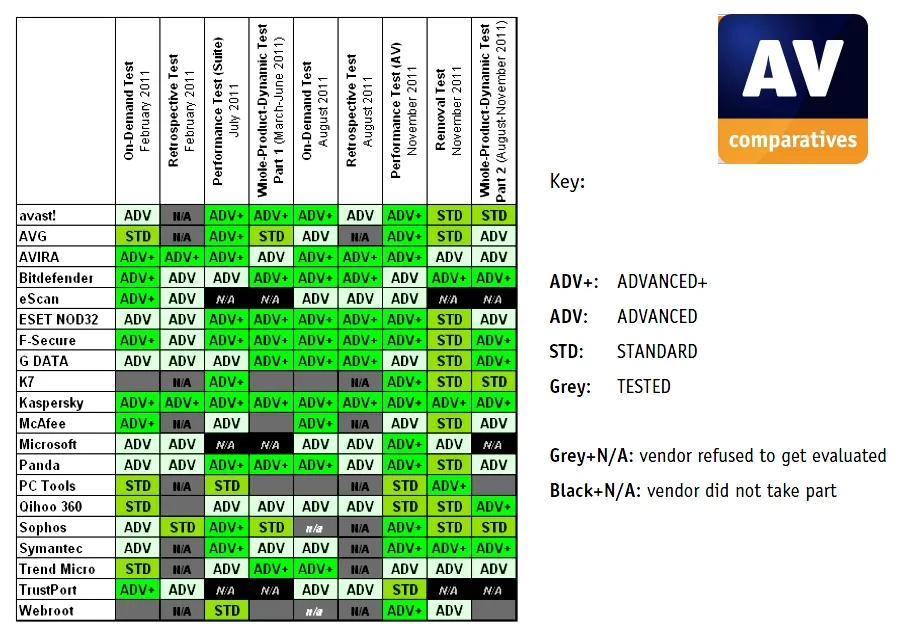
Here, the highest score is ADV+ and the lowest is STD.
To sum up, the top 5 antivirus are:
- Kaspersky
- F-Secure
- Bitdefender
- Avira
- ESET NOD32
The full PDF document can be downloaded here
Finally, I recommend that whenever you download any program, you do it from the official website. The danger is that software hosted on an unofficial site could have been altered and contain a malicious program. That’s why downloading an antivirus from an unofficial site is even riskier.

AI Platform Engineer & Full-Stack Developer
Building Enterprise Integrations & Automations
- What an LLM really is — and how to measure it with Artificial Analysis - 12 September 2026
- AI SDLC: a compendium of best practices for developing with AI - 19 June 2026
- Agentic Patterns and the Many Faces of RAG - 25 May 2026