HTTP, HTTPS, WWW… what are we talking about?
Translated from the Spanish original. Read in Spanish
Every day we use lots of terms related to the internet, but… do we really know what they mean? Here’s a short glossary of some computing terms we use, sometimes without even realising it.
Those three letters that sometimes come before every web address… WWW.
WWW stands for “World Wide Web”. The World Wide Web is the worldwide system for distributing documents and multimedia resources — in other words, the web pages we visit every day are part of the WWW. Although many website addresses start with “www”, you don’t need it to reach a website. Some examples:
HTTP
This is the part that comes before the name of the website we type into the browser. Basically, it’s the kind of “road” (the communication protocol) used to talk to the computer (the server) that hosts the web page.
HTTPS
The same, with one addition. The “S” at the end means the communication is secure — the data travelling from my computer to the server is encrypted.
Web server
Simply a computer that holds the actual files (text, images, etc.) of a website. It’s also set up in a particular way to “listen” for someone requesting a site (which happens after we type an address into the browser and press Enter) and send all the necessary information to our computer.
Any home computer can be set up as a web server.
IP address
It’s basically the same idea as our phone number (a series of numbers that identifies us and lets people reach us). When we sign up for an internet service, we’re given a number that identifies us. The same goes for web servers: they have an IP address that identifies them. Every device that connects to the internet has an IP address. Without going into detail, IP addresses can be numbers or a combination of numbers and letters.
Domain
Simply a friendly name used, for example, to reach a web page (e.g. gmail.com). Each domain is “linked” to an IP address and can therefore locate its web server.
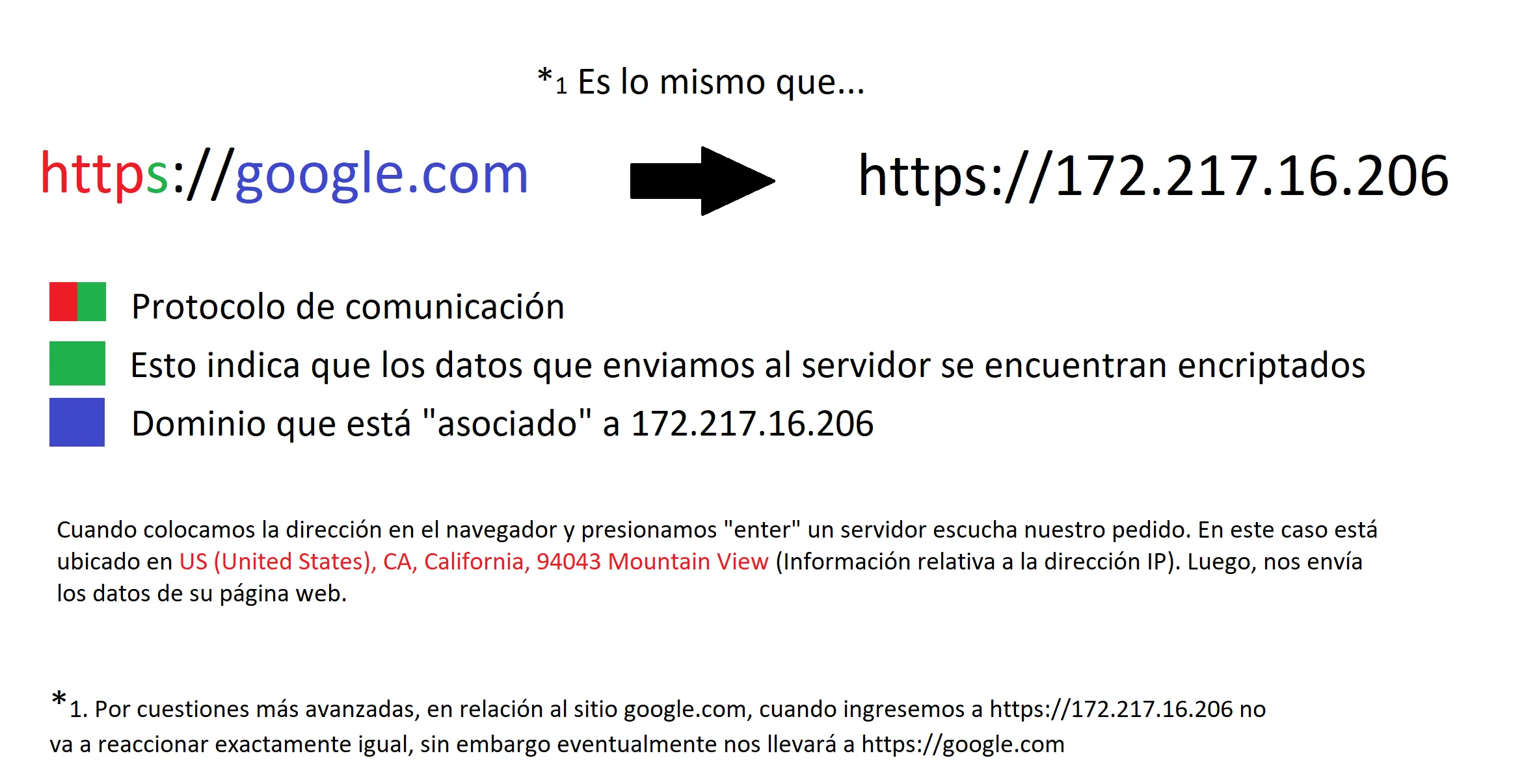
To sum up… let’s see what happens when we want to visit https://google.com/

AI Platform Engineer & Full-Stack Developer
Building Enterprise Integrations & Automations
- What an LLM really is — and how to measure it with Artificial Analysis - 12 September 2026
- AI SDLC: a compendium of best practices for developing with AI - 19 June 2026
- Agentic Patterns and the Many Faces of RAG - 25 May 2026